
Find the right model. Switch with confidence.
Test open-weight AI models, compare failures, speed and costs, then switch your active test model or inspect an Otari routing policy.
Three steps to a model decision
A recommendation only matters when it changes the next request. ModelSwitch makes that step explicit and inspectable.
Test
Run the same bounded, synthetic fixture against a permitted open-weight model.
Compare
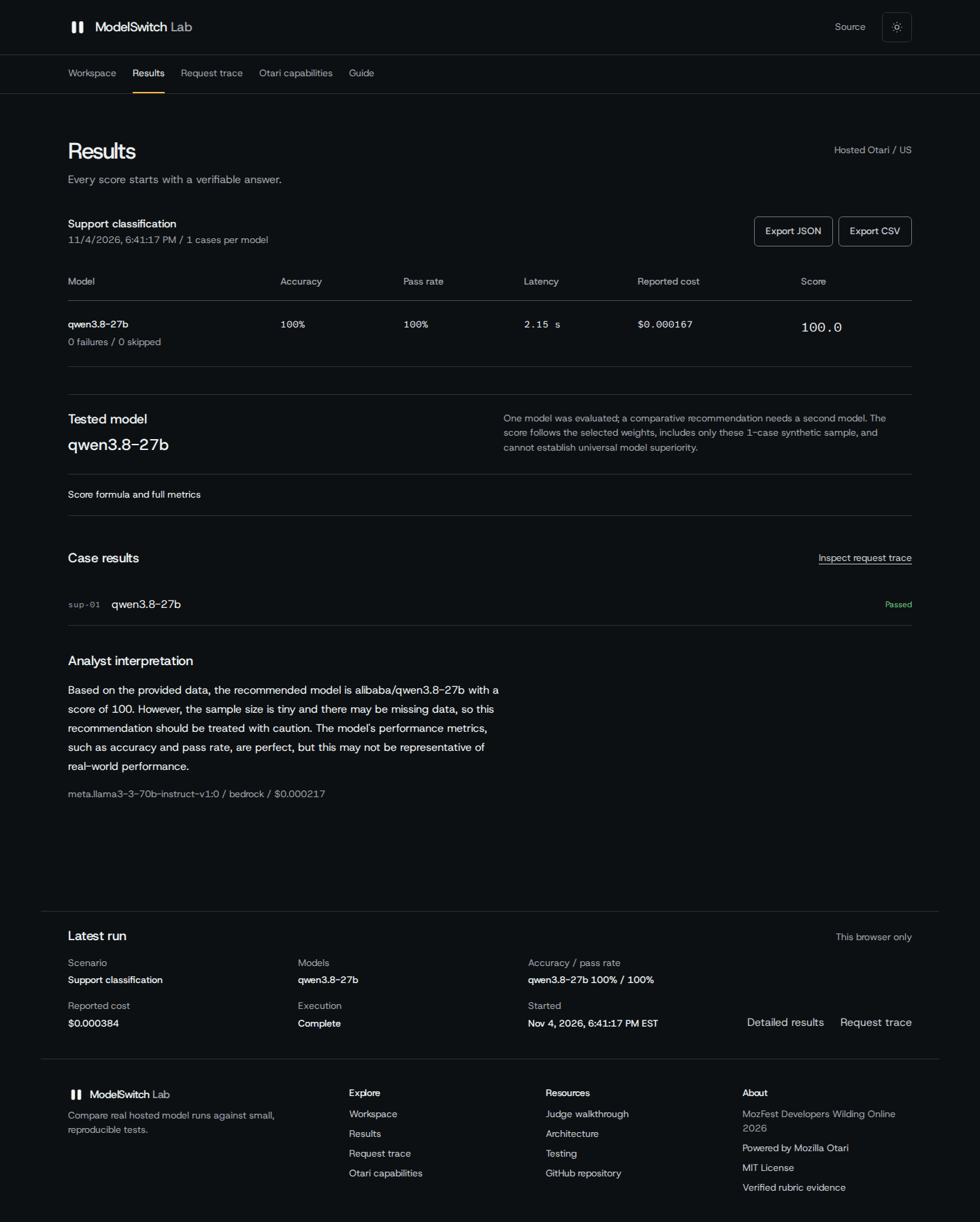
Check its output against known fields. Inspect accuracy, schema validity, latency, reported cost and request errors.
Switch
Choose another active test model and send the same fixture through Otari. The analyst role stays independent.
See where a model lets you down.
Small, reproducible tests surface the differences that matter before you choose a model for a workload.
- Incorrect fields or categories
- Invalid structured output
- Failed or interrupted requests
- Slower responses or higher measured cost
- Provider selection and routing events reported by Otari
A switch is not a fallback.
ModelSwitch keeps user choice and gateway behavior separate.
- Recommendation
- A deterministic suggestion from the benchmark results and selected objective.
- Model switch
- Your browser-scoped choice changes the model ID on later ModelSwitch test requests.
- Otari routing
- A named policy sent to the hosted gateway; Otari reports which model and provider served it.
- Fallback
- A gateway event only when Otari reports an attempted backup. A successful primary means no fallback occurred.
Open the evidence.
Inspect the real request trace, hosted capability receipts and the steps to reproduce each verified integration.